
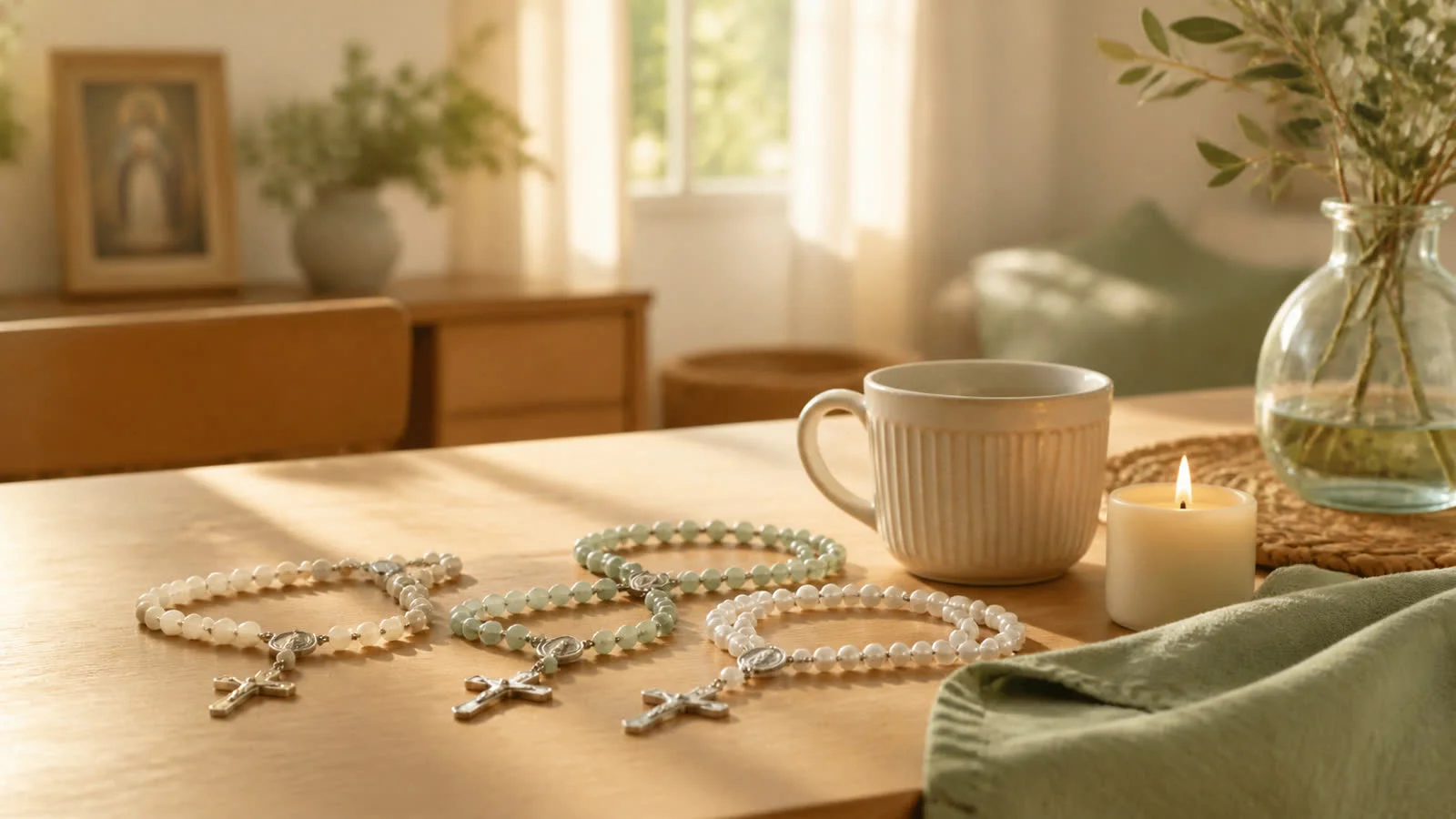
Family life can be full of love and interruption at the same time. There are meals to prepare, school runs, work messages, washing, appointments, bedtime routines and unexpected needs. If you wait for the house to become completely quiet before praying, the opportunity may keep moving further away.
That does not mean prayer has to become another source of pressure. A family Rosary or a personal Rosary within family life can be simple, flexible and imperfect. The goal is not to create a photograph of a peaceful household. It is to make a real place for prayer among the people and responsibilities already there.
Start with a realistic window
Look at the parts of the day that actually repeat. Perhaps there is a few-minute pause after school drop-off, before dinner, while a baby is settled, or after the children are in bed. You do not need to choose the most spiritual-looking time. Choose a time that has a reasonable chance of existing.
If evenings are often unpredictable, a morning decade may be easier. If mornings are rushed, a short prayer during a walk or before leaving the car may work better. A plan that respects family reality will last longer than one that depends on everyone being calm at the same time.
It helps to have a primary and a backup moment. Your primary plan might be a full Rosary after dinner. Your backup could be one decade with guided audio while you walk. The backup is not a failure. It is a way of keeping prayer connected to the day when the original plan disappears.
Let children see prayer without making them perform
Children learn from what they see repeated. They do not need to deliver a perfect prayer or sit still for an unrealistic length of time. They can observe a parent holding a Rosary, hear a familiar prayer, ask questions or join for part of the time.
Keep expectations appropriate to age. A young child may join for a few prayers, hold a bead, listen to a mystery or draw quietly nearby. An older child may choose an intention or lead a prayer. Participation can grow gradually.
Try not to use the Rosary as a test of behaviour. If the atmosphere becomes tense, shorten the prayer and protect the relationship. A child should be able to associate prayer with welcome, honesty and steadiness rather than fear of getting every movement right.
Share the practical roles
If more than one person is praying, decide who will begin, who will lead the prayers and who will hold the intention. Roles can rotate. This gives everyone a way to participate without making one person responsible for the whole experience.
A guided Rosary can help when the group is new to the prayers or when nobody wants to keep track of the sequence. Beadlight’s audio can carry the spoken prayers while the family remains together. Hands-free prayer can be helpful when someone is holding a child, sitting with an older relative or walking slowly around the room.
The tool should serve the group. Keep the volume comfortable, choose a calm style and avoid turning the setup into a long technical process. If the technology becomes the focus, return to the simplest available way to pray.
Choose intentions that belong to family life
A shared intention can make the Rosary feel connected to the week. Pray for someone who is unwell, a friend beginning a new job, a relative who is travelling, a family decision or people experiencing hardship. You can also pray in gratitude for something good that happened.
Let each person offer an intention if they want to. No one should be forced to share private information. A child may ask for a pet, a friend or a small worry to be remembered. Listen respectfully even when the intention seems different from what an adult would choose.
The intention does not need to be solved during the prayer. It is simply a way of bringing care into the moment. After the Rosary, practical action may still be needed: a phone call, an apology, a meal, a conversation or professional support.
Make interruptions part of the plan
Someone will need the bathroom. A delivery will arrive. A child will ask a question. A phone may ring. Family prayer is not protected from family life.
When an interruption happens, respond to the person in front of you. Pause the prayer if necessary. Return when you can, or finish for the day if that is the wise choice. You do not have to show that prayer is more important than every human need. Care itself can be part of the way you live your faith.
If you lose your place, use the beads, audio or a short pause to find the next prayer. Do not spend more time apologising for the interruption than returning to the prayer.
Protect a small tradition
A family does not need a daily full Rosary to have a meaningful prayer rhythm. A weekly Rosary, a decade on a particular evening, or a short prayer before a journey can become a tradition. Consistency grows from repeated experiences, not from the size of the promise.
Choose a place for the Rosary to rest. Let a child help light an electric candle or arrange the space safely. Keep the moment recognisable but flexible. Over time, the simple act of gathering can become something family members remember and return to.
Busy family life will never be perfectly organised. Prayer does not need it to be. Begin with a realistic window, let people participate honestly, welcome interruptions and keep the next step small. The Rosary can find a place in the middle of ordinary family life.
A family rhythm also benefits from a little preparation. Keep the beads where they can be found instead of storing them in a place that requires a search. Let everyone know that joining for one decade is welcome, even if they cannot stay for the whole prayer. If a baby needs attention or a meal needs finishing, pause without turning the interruption into a reason to abandon the habit forever. You can return when the moment allows. Children may ask questions, fidget or lose interest; that does not mean the gathering has been pointless. They are seeing prayer take place inside a real home, alongside real responsibilities. Invite older children to choose an intention or lead a prayer when they want to. A gentle pattern, repeated without pressure, can make the Rosary feel like part of family life rather than an extra performance everyone has to get right.